Views: 0 Author: Site Editor Publish Time: 2025-12-22 Origin: Site


Arch fenders are a crucial component in protecting both ships and docking infrastructure during the docking process. With the ever-growing demand for efficient and effective marine impact protection, understanding the various types of arch fenders available is essential for selecting the most suitable option for your specific needs. In this article, we will explore the different types of arch fenders, discuss their applications, and help you make an informed decision when choosing the right one for your port or terminal.
Understanding the arch fender taxonomy is essential for ensuring that the fender selected matches the needs of the environment in which it will be used. Whether it’s for high-traffic marine terminals or tight docking spaces, each type of arch fender has its unique characteristics that make it suitable for different applications. We will dive into the common types, features, and benefits of these fenders, making sure you know exactly what each type offers.
An arch fender is characterized by its distinctive V-shape or arch-like design, which allows for efficient impact absorption and distribution. The primary role of any arch fender is to mitigate the impact forces generated when a vessel docks, ensuring that the infrastructure and the vessel itself are protected from damage. The arch shape is specifically designed to absorb the energy from the docking ship while minimizing the reaction forces transmitted to the dock.
The key characteristic that defines an arch fender is its ability to compress and absorb energy effectively. The fender's arch design enables it to flex and conform to the shape of the ship, thereby reducing the force of the impact. The main advantage of this type of fender is its ability to handle high-energy impacts while maintaining a low reaction force, which makes it particularly effective in busy, high-traffic dock areas.
The standard arch fender is the most commonly used type in marine applications. It features a simple V-shape and is designed for general-purpose use at docks and berths where a high level of protection is required, but where space is not a major constraint. These fenders are particularly useful for accommodating various ship sizes, from small boats to large vessels.
Standard arch fenders are ideal for ports and terminals where space is somewhat available but impact energy absorption and minimal maintenance are still required. The simplicity of the design ensures cost-effectiveness and efficiency for everyday operations.
Pros:
Cost-effective: Due to its simple design, the standard arch fender is relatively affordable compared to other specialized fender types.
Versatile: Works well in a variety of applications, making it suitable for most marine environments.
Effective impact absorption: Provides strong energy absorption capabilities, reducing the risk of damage to both ships and docking infrastructure.
Cons:
Limited customization: While versatile, it may not be ideal for environments that require specific customization in terms of size or shape.
Bulkier than more advanced options: In environments where space efficiency is paramount, the standard arch fender may take up more room than other fender types.
The arch fender with UHMW-PE face is designed with a layer of Ultra High Molecular Weight Polyethylene (UHMW-PE) material. This panel provides additional benefits for abrasion resistance and friction reduction, making it particularly useful in high-traffic and high-impact docking environments. The UHMW-PE face protects the rubber components of the fender from wear and tear, increasing the longevity of the fender while also enhancing its performance.
The addition of UHMW-PE to the arch fender enhances its ability to withstand the repetitive friction caused by ships docking and maneuvering. This reduction in friction helps prevent damage to both the fender and the dock. Additionally, the UHMW-PE face reduces maintenance costs by extending the lifespan of the fender and minimizing the frequency of repairs.
Benefits include:
Increased lifespan: The wear-resistant properties of UHMW-PE significantly extend the service life of the fender.
Lower friction: Reduced friction means less wear on the vessel’s hull and dock infrastructure.
Cost-effective: Fewer repairs and replacements lead to reduced overall maintenance costs.
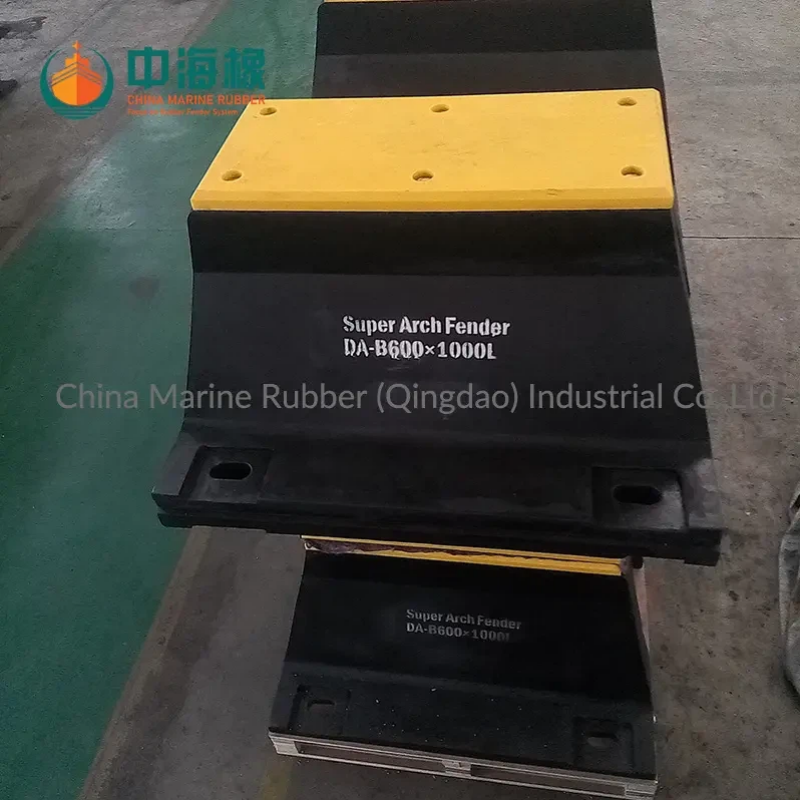
An arch fender with a steel pile head plate is an enhanced version of the standard arch fender. It incorporates a steel plate at the top of the fender, providing additional strength and durability. This design is particularly suited for applications where additional structural integrity is needed to withstand extreme impacts.
This type of arch fender is most commonly used in areas that require reinforced protection, such as high-traffic ports, deepwater terminals, and large industrial docks. The steel pile head plate ensures that the fender can handle higher loads and more intense impacts without compromising performance.
Ideal applications include:
Large commercial ports: Where heavy vessels frequently dock.
Industrial docks: That require additional strength due to the size and weight of the ships.
Heavy-duty docking: Where there is a need for long-term durability under frequent and intense impacts.
The steel pile head plate adds considerable strength, making it perfect for areas that face high-impact forces from large ships.
While the three main types of arch fenders discussed above are widely used, there are also additional variations and custom designs available to meet specific operational needs.
Fenders can be customized to suit the particular layout of the docking area. For example, arch fenders can be mounted either horizontally or vertically depending on the space constraints and the type of vessel being accommodated. Horizontal mounting is typically preferred for larger vessels that need to dock at a parallel angle, while vertical mounting is often used for compact spaces where space efficiency is critical.
Certain docks or terminals may have unique berth profiles that require customized fender designs. This could include specific height, width, or impact absorption needs. Custom arch fender designs can be created to meet these requirements, ensuring the fender provides the most effective protection possible for the unique layout of a specific dock.
When selecting an arch fender for your project, several factors should be considered to ensure you choose the right fender for your application.
The most important factors to consider when choosing an arch fender are the berthing energy and the size of the vessels that will be docking. Larger vessels require higher energy absorption capabilities, and the fender must be sized accordingly to handle these impacts. Additionally, the environmental conditions, such as tides, currents, and water temperature, should also be considered when selecting the material and design of the fender.
The quality of materials used in the fender, including the rubber and any additional components such as UHMW-PE or steel pile head plates, directly impacts the durability and longevity of the fender. Investing in high-quality materials will ensure that the arch fender performs optimally over a long period and withstands the harsh conditions of marine environments.
In conclusion, arch fenders are a vital part of any marine docking system. The different types of arch fenders—from standard to UHMW-PE faced and steel pile head plate versions—provide various levels of protection and durability to meet specific needs. Each type has its ideal applications and benefits, making it important to choose the right one based on factors such as vessel size, berthing energy, and environmental conditions.
For high-quality arch fenders designed to meet the toughest marine demands, contact us at China Marine Rubber (Qingdao) Industrial Co., Ltd. We specialize in manufacturing durable marine fenders that offer superior performance and longevity, ensuring that your dock infrastructure remains protected for years to come.
1. What is the main advantage of an arch fender?
The arch fender is designed to absorb high-energy impacts while maintaining low reaction forces, making it ideal for protecting both ships and dock infrastructure.
2. What types of arch fenders are available?
The main types of arch fenders include the standard arch fender, the arch fender with UHMW-PE face for abrasion resistance, and the arch fender with steel pile head plate for added durability.
3. Where are arch fenders most commonly used?
Arch fenders are commonly used in busy ports, terminals, and marine berths where they provide protection against high-impact forces from large vessels.
4. How do I choose the right type of arch fender for my dock?
When choosing an arch fender, consider factors such as berthing energy, vessel size, environmental conditions, and material quality to ensure the fender meets the specific needs of your docking environment.