Views: 0 Author: Site Editor Publish Time: 2026-08-08 Origin: Site


Tugs and frame docks face continuous, high-friction operational cycles every single day. Standard fendering solutions often fail to balance heavy impact absorption alongside delicate surface protection. The maritime industry demands specialized materials to prevent expensive structural damages. Black carbon-based fenders cause severe hull marking and abrasive wear during daily operations. Poorly profiled fenders transfer excessive reaction force directly to rigid dock frames. This dynamic stresses vessel hulls and port infrastructure unnecessarily. This article outlines the technical justification for upgrading your protective systems. We detail installation realities and compliance criteria for these essential upgrades. You will learn how specific fender profiles operate safely in demanding maritime environments. We guide you through material properties, structural layouts, and practical mounting strategies to protect your critical assets.
Non-Marking Performance: White rubber formulations eliminate carbon-black scuffing, significantly reducing hull cleaning and repainting costs.
Optimal Geometry: The D-Type profile provides a flat mounting base with high energy absorption, ideal for narrow frame docks and tugboat perimeters.
Verified Reliability: Requiring Bureau Veritas (BV) certification ensures the material meets strict marine durability and aging standards.
Lifecycle ROI: Proper sizing (e.g., DD150) and precise hardware selection minimize shear failure during heavy lateral berthing.
Marine environments punish unprotected structural assets mercilessly. You must protect rigid dock frames and vessel hulls from kinetic energy impacts. Berthing vessels carry massive momentum. When they contact a dock, this kinetic energy must dissipate safely. D-Type rubber fenders excel in these specific high-impact zones. They offer a highly proportional compression curve. They absorb kinetic energy effectively during berthing operations. The hollow central chamber allows the material to fold inward smoothly under pressure. Most importantly, they perform this action without transferring damaging reaction forces to the underlying structural frame. High reaction forces frequently fracture concrete docks or dent steel vessel hulls over time.
Mounting stability remains a critical factor for maritime engineers. Cylindrical profiles require complex suspension chains or elaborate tensioning systems. The flat back of a D-Type profile allows for direct, flush mounting. You can bolt them directly against tugboat hulls and rigid dock frames. This streamlined approach minimizes hardware wear. It also simplifies routine maintenance inspections significantly.
You measure operational success through tangible efficiency gains. Upgraded protective systems drastically reduce downtime for structural repairs. They lower maintenance overhead across fleet operations. They ensure uninterrupted port activities even during adverse weather conditions.
The following performance matrix illustrates how profile geometry affects structural safety during operations.
Performance Metric | D-Type Profile | Cylindrical Profile | Operational Impact |
|---|---|---|---|
Energy Absorption | High proportional collapse | Gradual compression | Reduces hull denting on impact |
Reaction Force | Low force transfer | Moderate force transfer | Protects rigid concrete docks |
Mounting Method | Flush bolting to flat frames | Suspension chains and brackets | Lowers installation complexity |
Shear Resistance | Excellent along the flat base | Prone to rolling under shear | Prevents tearing during angled berthing |
Always calculate the maximum berthing velocity of your heaviest anticipated vessel. You must select a profile size capable of absorbing this exact kinetic load. Relying on oversized profiles increases costs unnecessarily. Relying on undersized profiles guarantees structural dock failure.
Aesthetics and maintenance budgets intersect directly in modern maritime operations. Conventional black marine rubber uses carbon black as a primary reinforcing filler. This chemical compound strengthens the material significantly. However, it leaves stubborn, expensive-to-remove black streaks on vessel hulls. Removing these aggressive scuff marks requires harsh chemicals and intense manual labor. Frequent repainting schedules drain operational budgets rapidly.
Advanced manufacturing now offers superior alternatives. We see modern formulations utilizing specialized non-marking agents instead of carbon black. Factories blend premium EPDM or high-grade natural rubber bases. These compounds maintain high tensile strength without leaching color. They absorb heavy impacts perfectly without transferring ugly residues onto passing hulls.
Certain operational sectors benefit immensely from this non-marking technology. You will find these profiles crucial for specific high-value applications.
Luxury Yacht Marinas: Protecting pristine fiberglass gel coats from abrasive color transfer during docking.
Naval Vessel Berths: Maintaining strict aesthetic and operational coating standards mandated by defense protocols.
Specialized Commercial Fleets: Supporting cruise terminals and passenger ferries where visual appeal directly influences customer perception.
Many operators mistakenly purchase cheap white rubber lacking proper UV inhibitors. Unprotected white rubber turns yellow and brittle after just one season under harsh sunlight. Always verify UV resistance before authorizing procurement.
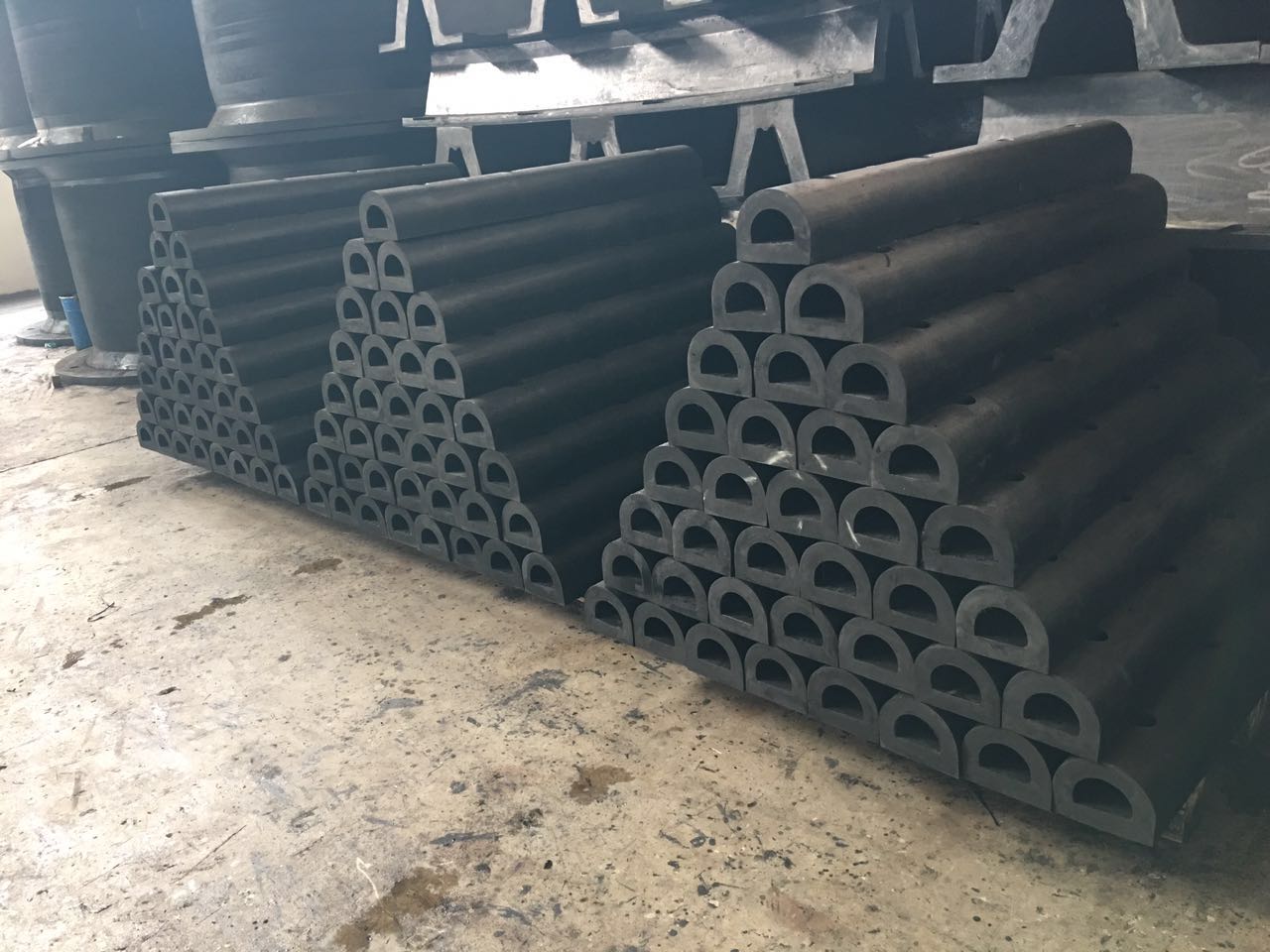
Selecting the correct profile determines the longevity of your protective system. We routinely compare D-Type shapes against W/M profiles for tugboats and frame docks. Each design serves a distinct mechanical purpose during vessel maneuvers.
W/M profiles handle extreme pushing operations seamlessly. You typically install them on the bow or stern of tugs. They feature heavy grooving to maximize physical grip against flat ship hulls. The grooves act like heavy tire treads, locking the tugboat into position. Conversely, D-Type profiles provide continuous lateral protection. They run seamlessly along the side belts of tugs or line the perimeter of narrow frame docks. They act as sliding bumpers rather than gripping blocks.
Your shortlisting logic should follow operational intent strictly. D-shapes provide consistent, uniform contact areas. They resist tearing under heavy shear stress far better than heavily ridged alternatives. W/M profiles often catch and tear if subjected to angled lateral sliding. You must deploy Rubber Fenders strategically across your entire fleet.
Choose the D-shape for versatile, all-around impact protection. You should reserve W/M profiles strictly for primary push-knees where maximum forward grip dictates operational success.
The chart below outlines the critical differences guiding procurement decisions.
Feature Comparison | D-Type Profile | W/M Profile | Ideal Application |
|---|---|---|---|
Surface Geometry | Smooth, continuous curve | Heavily grooved and ridged | Determines grip vs. slide capabilities |
Primary Function | Lateral impact absorption | Forward pushing and locking | Matches the vessel's daily maneuvers |
Shear Tolerance | High resistance to tearing | Low tolerance for sliding shear | Prevents premature material failure |
Installation Zone | Side belts, frame dock perimeters | Bow and stern push-knees | Dictates hardware layout requirements |
Material failure in maritime environments creates dangerous operational liabilities. Uncertified rubber degrades rapidly under intense UV exposure. Constant saltwater immersion and severe temperature fluctuations break down weak chemical bonds. You cannot visually assess the internal durability of a newly molded profile. A cheap fender looks identical to a premium one on the warehouse floor.
Bureau Veritas (BV) standards eliminate this operational guesswork entirely. This certification ensures the rubber formulation passes independent, rigorous testing. Testing facilities verify critical metrics like tensile strength, elongation at break, and ozone resistance. "Elongation at break" proves the material can stretch significantly before tearing. Certified materials maintain their elastic properties after years of punishing environmental exposure.
Evaluating precise specifications removes procurement ambiguity. Specifying a BV-Certified White DD150 D-Type Rubber Fender guarantees a standardized 150mm x 150mm profile. This exact sizing establishes a predictable baseline for engineering calculations. A 150mm standoff distance keeps delicate hulls away from jagged concrete edges reliably. It simplifies compliance audits and port safety inspections universally.
Trust requires verifiable documentation in marine engineering. Always request material test reports (MTRs) before finalizing any procurement contract. Demand third-party certificates to validate supplier claims fully. Genuine BV certification protects your structural investments reliably.
Proper installation guarantees the engineered lifespan of your protective systems. Heavy-duty marine environments dictate specific hardware requirements. You must use galvanized or 316 stainless steel anchor bolts exclusively. Standard fasteners corrode rapidly in saltwater. This corrosion causes sudden dislodgement during active berthing, leaving your dock entirely exposed.
Installation teams face several mechanical risks during physical deployment.
Over-torquing: Excessive tightening crushes the flat mounting base instantly. This compromises the structural integrity and ruins the energy absorption capacity. Installers should stop tightening once the washer firmly bites into the rubber.
Improper Spacing: Excessive gaps between bolts lead to severe sagging. It also causes localized shear failure during angled berthing impacts.
You must evaluate continuous versus segmented layouts carefully. Assess whether a continuous extruded length suits your specific application. Extrusions accommodate the smooth, sweeping flex of a tugboat hull nicely. Segmented, pre-drilled blocks often serve rigid spans of frame docks better. Segmented layouts allow maintenance crews to replace a single damaged block easily. They do not have to remove an entire ten-meter extrusion.
While white materials eliminate paint transfer, they still require ongoing operational maintenance.
Inspect anchor points periodically for bolt-loosening and hidden galvanic corrosion.
Check exterior surfaces for localized tearing caused by sharp hull protrusions or broken metal fittings.
Wash marine growth from the rubber surface periodically to maintain optimal surface friction and aesthetic appeal.
Upgrading to white D-Type marine fenders represents a calculated structural decision. It prevents costly hull marking and ensures stable mounting across all high-impact zones.
These specific profiles deliver reliable impact resistance without transferring damaging reaction forces to rigid port infrastructure.
Always review your vessel or dock's maximum kinetic energy requirements thoroughly before purchasing.
Cross-reference your energy data with DD150 load and deflection tables to ensure structural compatibility.
Consult directly with a BV-certified supplier to finalize your hardware sizing and layout strategy successfully.
A: No, provided they are manufactured with UV-resistant EPDM or equivalent marine-grade compounds. High-quality white rubber holds certifications like BV to verify exceptional aging resistance against sunlight and saltwater.
A: Bolt spacing depends on the operational shear load and installation surface. Standard marine engineering practice typically places stainless steel anchor points every 300mm to 400mm along the flat base to prevent sagging.
A: Yes, smaller and mid-sized D-Type fenders can be pre-curved during manufacturing. Installers can also flex them on-site to match the hull's radius. However, sharp hull angles usually require a segmented block installation.